What is an Odour Assessment — and Why is it More Than Just Deciding Whether Something Smells?
One of the things people are often surprised to learn about my work is that part of my job involves having my sense of smell tested and calibrated.
Yes, really.
As an odour practitioner, I hold an up-to-date Odour Acuity Test certificate in accordance with EN 13725. In simple terms, this means my ability to detect odours is periodically tested against a recognised standard using n-butanol.
It is not usually what people imagine when they hear the words “air quality consultant”.
But that is part of what makes this area of work so interesting.
Environmental consultancy is often seen as technical reports, planning policy and data analysis — and it is all of those things. But it is also fieldwork, professional judgement, observation, experience and understanding how environmental issues affect people in real places.
Odour assessment is a good example of that.
Why odour matters in planning
Odour can be an important planning issue for certain types of development.
This might include wastewater treatment works, waste-handling and treatment facilities, industrial processes, rural and agricultural activities, commercial kitchens, or new homes and sensitive uses proposed close to existing odour sources.
Odour is also one of the more sensitive environmental topics.
Unlike some pollutants, odour is often experienced very personally. What one person considers a minor smell, another may find intrusive, unpleasant or unacceptable. It can affect how people feel about their homes, workplaces, schools and local communities.
That is why odour should not simply be dismissed as subjective.
A proportionate, evidence-led assessment can help everyone involved understand the likely level of risk and whether a site is suitable for the proposed use.
What is an Odour Assessment?
An odour assessment considers whether odour could affect people who live, work or spend time near a development.
It may be needed where a new development is proposed close to an existing odour source. For example, new homes near a wastewater treatment works, farm, waste facility or industrial process.
It may also be needed where the proposed development itself could introduce a new odour source, such as food preparation, waste storage, agricultural activity or industrial operations.
The aim is not simply to decide whether something smells.
The aim is to understand:
- what the source of odour is;
- how often odour may occur;
- how intense or unpleasant it may be;
- how likely people are to be exposed to it;
- whether the proposed land use is appropriate; and
- whether mitigation, management or design changes are needed.
In planning terms, the key question is usually whether odour could lead to an unacceptable impact on amenity.
Why early assessment helps
Development should be guided to appropriate locations.
Where odour is likely to be an issue, it is much easier to consider separation distances, site layout, ventilation, building orientation, source controls or mitigation measures early in the design process.
Leaving odour until late in the planning process can create avoidable problems.
It can lead to objections, requests for further information, planning conditions, redesign, or uncertainty around whether a scheme is acceptable in its proposed form.
Early advice does not necessarily mean a development cannot proceed. In many cases, it helps identify a proportionate way forward.
Where odour can get missed
Odour is not always obvious at the start of a project.
It can be missed where a site looks suitable on paper, but is close to an existing source such as a wastewater treatment works, farm, commercial kitchen, industrial unit or waste operation. It can also be missed where a proposed use introduces new odour sources, such as extract systems, refuse storage, process emissions or agricultural activity.
This is where early environmental input can make a real difference.
Sometimes a simple review is enough to confirm that odour is unlikely to be a significant issue. In other cases, it can highlight the need for further assessment, layout changes, separation distances, ventilation strategy or mitigation before the design becomes fixed.
The key is understanding the risk early enough for the advice to be useful.
How odour is assessed
he right approach depends on the site, the source, the proposed development and the level of planning risk.
An odour assessment may include:
- review of the site and surrounding land uses;
- identification of odour-sensitive receptors;
- review of planning history, permits, complaints or operational information;
- field odour surveys or sniff testing;
- consideration of local wind conditions and exposure pathways;
- source-pathway-receptor assessment;
- review of design and mitigation measures; and
- dispersion modelling, where appropriate.
Not every project needs complex modelling. Some schemes can be assessed using a qualitative, risk-based approach. Others need more detailed evidence to support a robust planning position.
The important thing is that the scope is proportionate to the risk.
The people behind the assessment
One of the reasons I enjoy odour work is that it brings together science, planning and real-world judgement.
It is technical, but it is also very human.
You are not just looking at a source on a plan. You are thinking about how a place will be experienced by the people who live, work, learn or spend time nearby.
That is also why I think it is important to talk more openly about what environmental and STEM careers actually involve.
As a female founder working in a technical STEM field, I also think it is important to show that environmental careers are varied, practical and genuinely connected to the places and communities we are trying to protect.
They are not always what people expect.
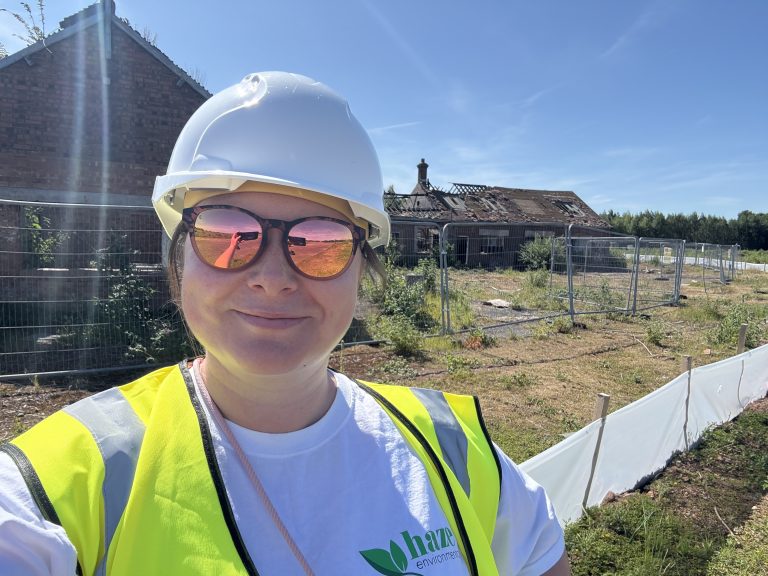
Sometimes they involve data, modelling and technical guidance. Sometimes they involve standing in a field recording observations. Sometimes they involve having your sense of smell tested to a recognised European standard. And sometimes they involve explaining a complex issue in a way that helps a project team make better decisions.
For me, that is where the value of good consultancy sits. It is not about overcomplicating a project or creating unnecessary assessment work. It is about bringing clarity, giving honest advice and helping clients understand what really matters — early enough for that advice to make a difference.
How Haze Environmental can help
Haze Environmental supports clients with odour assessments across the UK, including assessments for planning applications, appeals, permitting and design advice.
With over 18 years of experience, membership of the Institute of Air Quality Management, and Chloe’s role on the IAQM Committee, Haze Environmental provides clear, proportionate and practical advice for developments where odour may be a material consideration.
Our work includes odour assessments for wastewater, waste, industrial, agricultural, rural and mixed-use developments, as well as advice on sensitive land uses proposed close to existing odour sources.
Odour can be a complex issue, but it does not need to become a late-stage planning problem.
If you are working on a development where odour may be relevant, early advice can help identify the likely risk, the appropriate assessment scope and any mitigation that may be needed.
Whether you are considering a site near an existing odour source, responding to local authority comments, or trying to understand whether odour could affect your planning strategy, Haze Environmental can help provide clear, proportionate advice.
To discuss an odour assessment for your project, contact Haze Environmental.
About Haze Environmental
Haze Environmental is an independent air quality and odour consultancy, supporting planners, architects and developers across the UK to manage planning risk and deliver healthier places.
Our mission is to make a positive impact — for the clients we work with and for the environment we all share.